C Program: Reverse a String
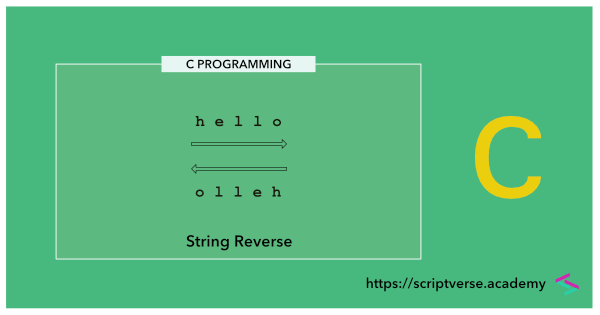
A reversed string has its characters re-ordered from the original string, starting from the last to the first. If the input string is "hello", the program should reverse it and print out "olleh".
For some versions of C, there already exist a built-in function called
strrev() for the purpose, available under
the <string.h> header library. The
input string needs to be passed as an argument to it; which then
reverses it.
The below program illustrates the use of the
strrev() function to reverse a given
string. Note the use of %[^\n] inside the
scanf() function for reading the string.
The difference is, with %s, the reading
goes off with the encounter of first space/blank character, while
%[^\n] accepts the spaces.
				#include <stdio.h>
				#include <string.h>

				int main() {
					char str[100];

					printf("Enter a string: ");
					scanf("%[^\n]", str);

					strrev(str);

					printf("The reverse of the entered string is %s \n", str);

					return 0;
				}
The strrev() function, however, is not
available for some versions of C, like the
C99.
Reversing a String Without strrev()
We can achieve the same without using the
strrev() function. In the below program,
two variables of type char —
str[] &
revstr[] — are declared to hold
the input string and the reversed string respectively. The
end variable counts the number of
characters of the given string, but is decremented with each
character assignment inside the second
while loop.
					#include <stdio.h>

					int main() {
						char str[100], revstr[100];
						unsigned short start = 0, end = 0;

						printf("Enter a string: ");
						scanf("%[^\n]", str);

						// count the number of characters
						while (str[end] != '\0')
							end++;

						// backward assignment, starting from the last character
						while (end > 0) {
							revstr[start] = str[end-1];
							end--;
							start++;
						}

						revstr[start] = '\0';

						printf("The reversed string is: %s", revstr);

						return 0;
					}